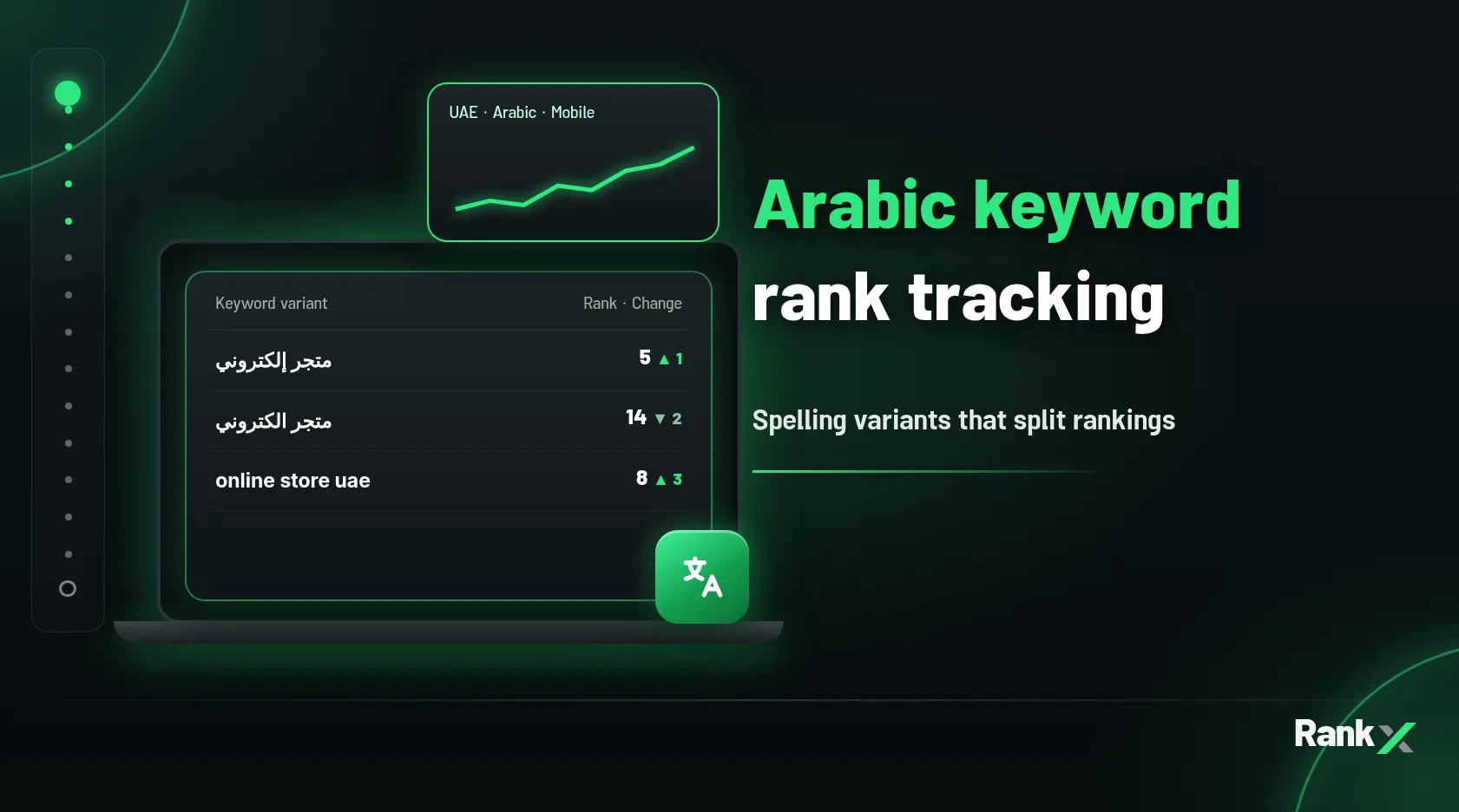
You manage Arabic keywords for a client. Your report shows one position, then the client searches on their own phone and sees something else. Often the cause is spelling: the client typed the word another way. Arabic keyword rank tracking only works when your list holds the spellings people actually type.
This guide covers the letter forms and mixed-language searches that can split Arabic rankings. It then gives you a repeatable variant audit: a way to decide which spellings to track as separate keywords and which to group. You can run it with a browser and a spreadsheet.
Why does Arabic keyword rank tracking need its own plan?
The short answer: one Arabic keyword is often typed in several spellings, and you cannot assume Google treats them as the same search. Some variants may bring back the same results. Others may not. The safe approach is to check each one rather than assume.
A keyword is the word or phrase people actually type into a search engine. So your tracked list should hold the spellings searchers use, not only the one the copywriter chose for the page.
Modern Standard Arabic is understood across the Arab world, but understanding a formal spelling is not the same as typing it. Searchers in the Gulf type quickly on phone keyboards, skip the hamza or use a dialect word; some even type Google itself as «قوقل». How often each form appears varies from keyword to keyword, which is exactly why the list needs checking.
Two terms for readers new to SEO tools. The SERP is the search results page: the list of pages Google shows for a search. A rank tracker is a tool that checks, on a schedule, where your page appears on the SERP for each keyword and shows how that changes over time. Our plain guide to rank tracking covers the basics.
Which spelling variants split Arabic rankings?
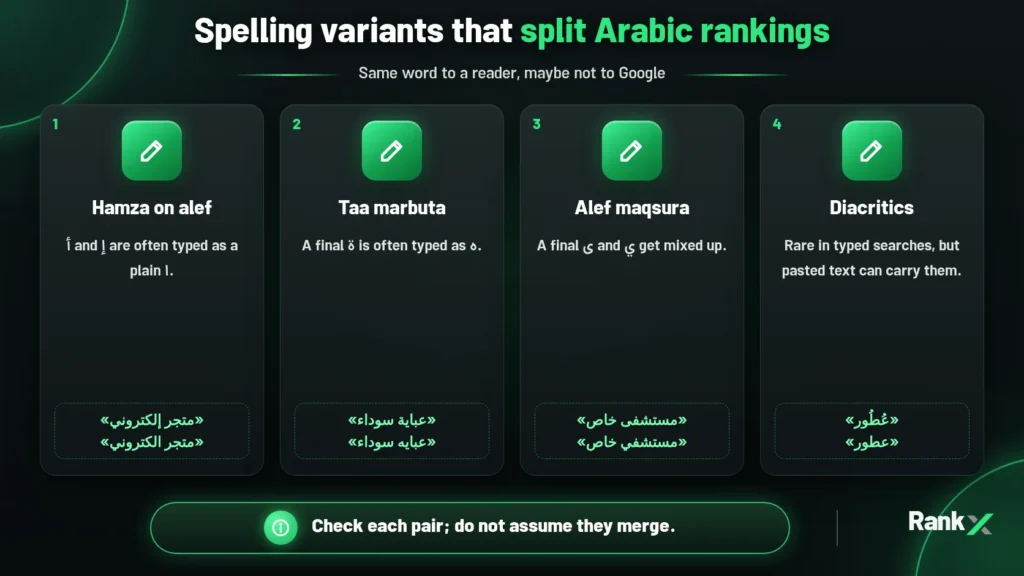
Arabic has several letters that people write in more than one way. Each pair below is the same word to a human reader. To a search engine it may or may not be the same query. The examples are terms a Gulf business could realistically track.
| Variant type | Form one | Form two | Example business |
|---|---|---|---|
| Hamza on alef (أ, إ, ا) | «متجر إلكتروني» | «متجر الكتروني» | An online store selling across the GCC |
| Hamza on alef (أ, إ, ا) | «أثاث مكتبي» | «اثاث مكتبي» | An office furniture retailer in Abu Dhabi |
| Taa marbuta or haa (ة, ه) | «عباية سوداء» | «عبايه سوداء» | A fashion shop in Dubai |
| Alef maqsura or yaa (ى, ي) | «مستشفى خاص» | «مستشفي خاص» | A private clinic group |
| With or without diacritics | «عُطُور» | «عطور» | A perfume shop |
Diacritics are rare in typed searches, but they can turn up when people paste text from a document or a social post. Google may match some of these pairs and keep others apart, and the answer can differ from one keyword to the next. A pair that merges for one term may split for another. That is why each pair is worth checking on its own.
How do Gulf searchers mix Arabic and English?
Searchers in the UAE switch between scripts, sometimes inside one query. How common each form is depends on the keyword, so treat this as a pattern to test. Anyone who works with Gulf clients will recognise these forms:
- A brand or product name typed in Latin letters inside an Arabic query
- Arabic words written in Latin letters (Arabizi), sometimes with numbers standing in for Arabic sounds
- The same need searched fully in English, such as “office furniture Abu Dhabi”
- A dialect word used in place of the formal term
Take a Dubai agency with clients in Riyadh and Doha. The same service term may need tracking in Arabic script, in English and in mixed form, because each version can bring up a different results page. A reliable rank check is set for a country and a language, on desktop or mobile, so the language of the check is part of the setup, not a detail. An Arabic query checked with an English interface language may not show what an Arabic-speaking searcher sees.
How do you audit spelling variants before you track them?
This is the core of the method. Run it before you add keywords to any tracker. The idea is simple: try every realistic way of writing the same keyword. The audit turns that into a routine you can repeat for every client.
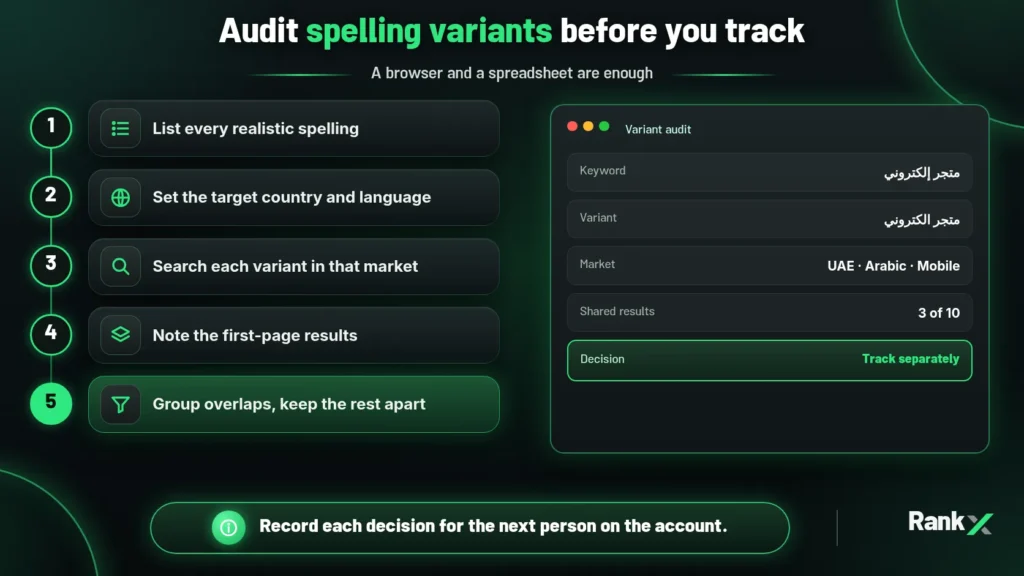
First, list every realistic spelling
Start with each keyword you plan to track. Next to it, write every spelling a real searcher might type: each letter-form variant from the table above, spacing differences such as «أونلاين» and «اون لاين», the English version, any mixed form and the colloquial word. Keep the list realistic. A variant nobody types is noise. Useful places to find real spellings are your client’s customer messages, the site’s own search box and the Performance report in Google Search Console, where the site uses it.
Then, search each variant in the target market
Search each variant the way a searcher in the target market would: the right country, the Arabic or English interface, and the device your client’s customers use. A private browser window helps, because your own search history is then less likely to shape what you see. Your browser can only show your own location, though, so for a market you are not in, use a rank check set to that country. For each spelling, note the pages that appear on the first page of results.
Finally, group the overlaps and keep the rest apart
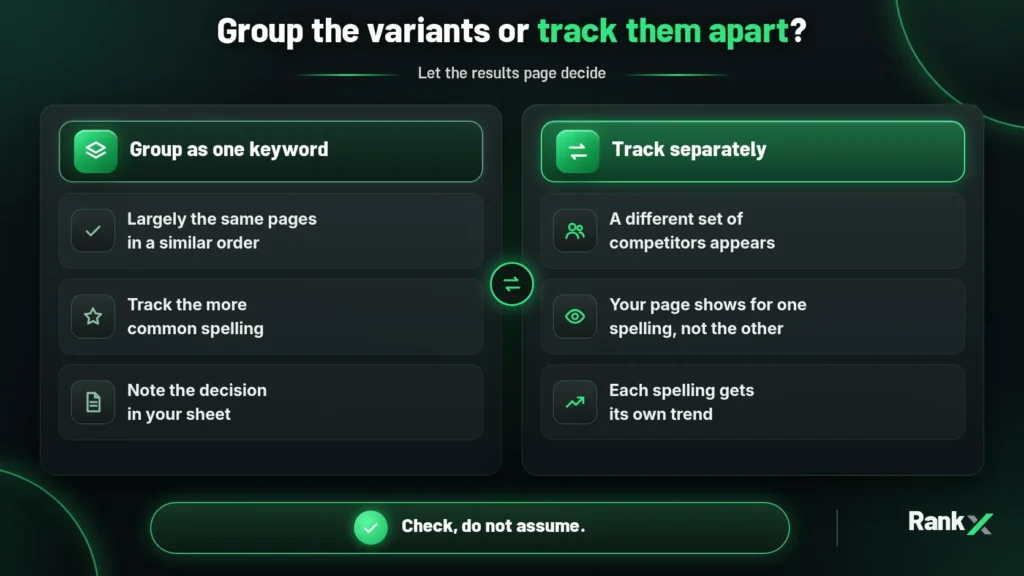
Compare the lists side by side. If two variants show largely the same pages in roughly the same order, you can treat them as one keyword and track the more common spelling. If the pages clearly differ, track each variant as its own keyword. Where you draw the line is a judgement call. A workable rule: if a different set of competitors appears, or your client’s page appears for one spelling and not the other, treat them as separate keywords. Record each decision so the next person on the account does not repeat the work.
Check, do not assume. Google may merge two spellings for one keyword and keep them apart for the next. Only a search in the target market tells you which.
How should you set up tracking per market and device?
Google results differ between countries and even between cities, because location is one of the signals Google uses. So a keyword tracked for Saudi Arabia and the same keyword tracked for the UAE are two separate things to watch, even when the spelling is identical. Treat desktop and mobile the same way.
For each keyword that came through your audit, set the market, the language and the device. In RankX, you add the client’s domain, choose the Google market (country, language, desktop or mobile) and add each spelling variant as its own keyword. Checks run every morning across the top 20 results, and the reports show which keywords moved up or down and which competitors appear for each spelling. A split between two spellings then shows up as two separate trends instead of being hidden inside one.
How do you read the results and act on them?
- Two variants rank differently. Consider using the more common spelling in the page title and headings, and the other form naturally in the body text. Treat this as a starting point, not a rule, and watch whether both trends respond.
- Other sites appear for one spelling only. Note them as competitors for that spelling. They may be targeting a variant your client has ignored.
- Your page does not appear for a variant. Check whether the page uses that form anywhere. If searchers type it, a natural mention in the text may help.
- New keywords arrive. Re-run the variant audit before you add them. It needs only a browser and a spreadsheet, so it works whether or not you use a tracking tool.
What should you do next?
Pick one client this week. Run the audit on their main Arabic keywords and compare what you find with the list you track now. If spellings you never tracked bring up different pages, add them as separate keywords for each market and device. If you report these rankings to clients, see our guide to writing an SEO report for clients.
Frequently asked questions
Does Google treat أ and ا as the same letter in searches?
Sometimes, but you cannot count on it for every keyword. Search both spellings in your target market and compare the results pages before you decide whether to track one or both.
Should I track Arabic and English keywords separately?
Yes, where a page serves both languages. A rank check can be set for a location and a language, so each language version can get its own check and its own trend.
Do I need separate rank tracking for Saudi Arabia and the UAE?
Yes. Google search results differ between countries and cities, so the same keyword in each market is its own entry.
How many spelling variants of a keyword should I track?
Only the ones that return clearly different results. Group variants that show largely the same pages and track the rest as separate keywords.